
At DigitalOrbitz, we help local businesses grow through smart digital marketing strategies. We work with businesses that want more website visitors, more phone calls, and more qualified leads using platforms like Facebook Ads and Google Ads. This guide shares our experience to help you choose the right advertising platform for your business.
Whether you own a local shop, clinic, restaurant, real estate company, coaching institute, or service business, this article will help you understand the difference between Facebook Ads and Google Ads and decide which one can generate better leads.
Facebook Ads vs Google Ads: Best for Local Business Leads
Online advertising has become one of the best ways for local businesses to find new customers. More people search online before buying a product or hiring a service. They compare businesses, read reviews, and visit websites before making a decision.
Two of the biggest advertising platforms today are Facebook Ads and Google Ads. Both platforms help businesses reach potential customers, but they work in very different ways.
Many business owners ask questions like:
- Which platform gives better leads?
- Which one costs less?
- Which platform gives faster results?
- Should I choose Facebook Ads or Google Ads?
The answer depends on your business goals, your target audience, and your budget.
In this guide, you will learn how each platform works, their advantages, and which one is better for local businesses.
Facebook Ads
Facebook Ads is Meta’s advertising platform. It allows businesses to show ads on Facebook, Instagram, Messenger, and the Meta Audience Network.
Instead of waiting for customers to search for your business, Facebook Ads helps you show your business to people who are likely to be interested.
For example, imagine you own a gym in Delhi. You can show your ads only to people who:
- Live within 10 km of your gym
- Are between 18 and 40 years old
- Like fitness pages
- Follow health influencers
- Recently searched for workout plans
- Have shown interest in weight loss
This level of targeting helps businesses reach the right audience before they start looking for a service.
How Facebook Ads Work
Facebook collects information based on user interests, activities, demographics, and online behavior.
Businesses create campaigns by selecting:
- Target audience
- Budget
- Ad placement
- Campaign objective
- Images or videos
- Call-to-action button
Facebook’s algorithm then shows your advertisement to people who are most likely to engage with it.
The platform keeps improving campaign performance by learning from user behavior.
Types of Facebook Ads
Facebook offers several ad formats.
Image Ads
These are simple ads with one image and a short message.
They work well for promotions, offers, and brand awareness.
Video Ads
Video ads grab attention quickly.
They are perfect for demonstrating products or explaining services.
Carousel Ads
These ads display multiple images or videos in one advertisement.
Businesses use them to showcase different products or services.
Lead Generation Ads
Lead Ads allow customers to fill out a form without leaving Facebook.
This makes it easier to collect:
- Names
- Phone numbers
- Email addresses
Local businesses often use this format to generate enquiries.
Story Ads
Story ads appear between Facebook and Instagram Stories.
They are full-screen and mobile-friendly.
Reels Ads
Reels have become one of the fastest-growing content formats.
Businesses use short videos to attract younger audiences and increase engagement.
Benefits of Facebook Ads for Local Businesses
Facebook Ads offers many advantages.
1. Highly Targeted Audience
One of the biggest strengths of Facebook Ads is audience targeting.
You can target users based on:
- Age
- Gender
- City
- Location
- Interests
- Income
- Education
- Job title
- Relationship status
- Shopping behavior
This helps reduce wasted advertising spend.
2. Excellent Brand Awareness
Many customers do not know your business exists.
Facebook helps introduce your business to thousands of local people every day.
Even if they do not buy immediately, they remember your brand.
Later, when they need your service, they may contact you.
3. Affordable for Small Businesses
Facebook Ads allows businesses to start with a small budget.
Even a local business with limited marketing funds can begin testing campaigns.
As results improve, the budget can increase.
4. Strong Visual Marketing
Photos and videos create emotional connections.
Restaurants can show delicious food.
Salons can display makeover videos.
Gyms can share transformation stories.
Real estate agents can upload property tours.
Visual content often increases engagement.
5. Easy Lead Collection
Lead Generation Ads remove unnecessary steps.
Customers submit their information directly inside Facebook.
This improves conversion rates.
6. Better Retargeting
Many people visit a website but do not contact the business.
Facebook allows businesses to show advertisements again to these visitors.
This process is called retargeting.
Retargeting usually produces higher conversion rates because customers already know the business.
Limitations of Facebook Ads
Facebook Ads is powerful, but it also has some limitations.
People Are Not Always Ready to Buy
Most users open Facebook to relax.
They scroll through photos, videos, and posts.
They are not actively searching for a business.
Because of this, some leads may take longer to convert.
Competition Is Increasing
More businesses advertise on Facebook every year.
This increases advertising costs in some industries.
Businesses need better creative content to stand out.
Creative Quality Matters
Poor images and weak copy reduce performance.
Successful campaigns need attractive visuals and persuasive headlines.
Google Ads
Google Ads is Google’s online advertising platform.
Unlike Facebook Ads, Google Ads reaches customers when they are actively searching for something.
For example, someone types:
- Dentist near me
- Digital marketing agency in Delhi
- Best plumber nearby
- CA services in Gurgaon
These people already need a service.
Google displays relevant advertisements above the organic search results.
Businesses only pay when someone clicks on their advertisement.
This advertising model is called Pay-Per-Click (PPC).
How Google Ads Work
Google Ads uses keywords.
Businesses choose keywords that customers search for.
When users enter those keywords, Google decides which advertisements to display.
Several factors affect rankings, including:
- Bid amount
- Ad quality
- Landing page experience
- Expected click-through rate
- Ad relevance
A well-optimized campaign often wins even if another advertiser spends more money.
Types of Google Ads
Google offers several campaign types.
Search Ads
These text ads appear at the top of Google Search.
They work well for businesses offering services.
Display Ads
Display ads appear on websites that partner with Google.
They increase brand awareness.
Shopping Ads
Shopping Ads display product images, prices, and store names.
They are ideal for eCommerce businesses.
Video Ads
These advertisements appear on YouTube.
Businesses use them for awareness and product promotion.
Performance Max Campaigns
Performance Max uses artificial intelligence to show ads across Google’s platforms.
It can display advertisements on:
- Google Search
- YouTube
- Gmail
- Maps
- Display Network
- Discover Feed
Benefits of Google Ads for Local Businesses
Google Ads offers several advantages.
1. High Purchase Intent
This is Google’s biggest strength.
People searching on Google usually have a problem they want to solve immediately.
For example:
- Emergency electrician
- AC repair near me
- Lawyer in Delhi
- SEO agency for small business
These users are much closer to making a purchase.
As a result, Google Ads often generates highly qualified leads.
2. Faster Lead Generation
Search Ads appear exactly when customers need a service.
Businesses can start receiving calls, enquiries, and bookings soon after launching a well-optimized campaign.
3. Excellent Local Targeting
Businesses can advertise within specific cities, areas, or even a few kilometers around their location.
This is perfect for local service providers.
4. Pay Only for Clicks
Unlike many traditional advertising methods, businesses usually pay only when someone clicks on the ad.
This makes advertising budgets easier to manage.
5. Strong Performance Tracking
Google Ads provides detailed reports.
Businesses can track:
- Clicks
- Calls
- Website visits
- Conversions
- Cost per lead
- Return on investment
These insights help improve future campaigns.
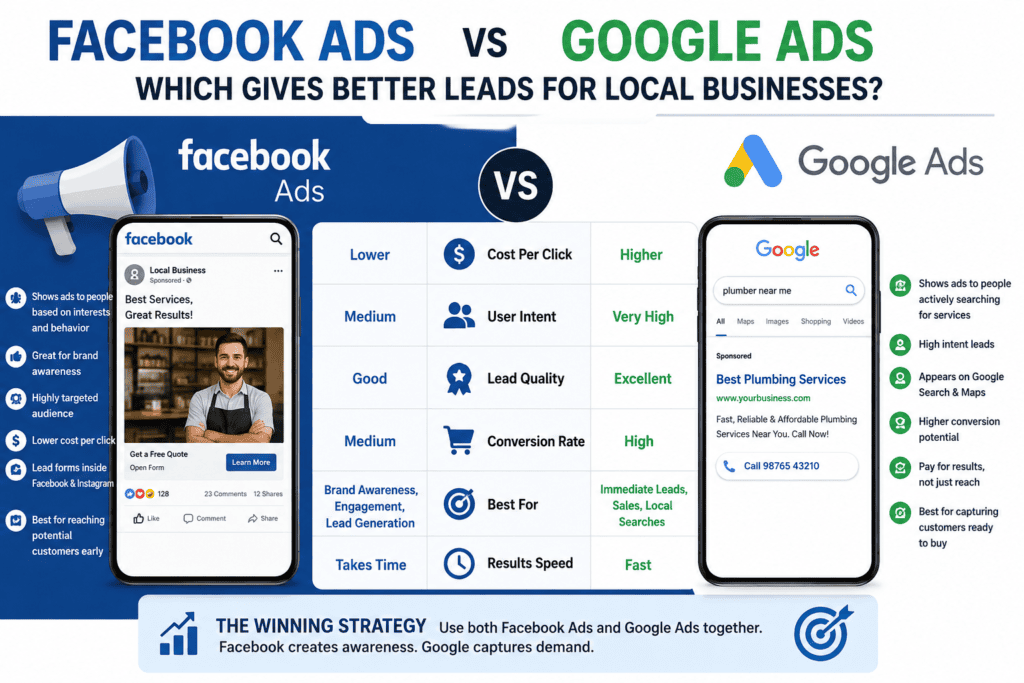
Facebook Ads vs Google Ads: A Detailed Comparison
| Feature | Facebook Ads | Google Ads |
|---|---|---|
| User Intent | Low to Medium | Very High |
| Best For | Brand Awareness, Lead Generation | High-Intent Leads, Sales |
| Targeting | Interests, Demographics, Behavior | Keywords and Search Intent |
| Cost | Usually Lower | Usually Higher |
| Lead Quality | Good | Excellent |
| Conversion Rate | Medium | High |
| Best Ad Format | Image, Video, Carousel, Lead Form | Search, Call Ads, Performance Max |
| Results Speed | Medium | Fast |
| Local Business Growth | Very Good | Excellent |
Lead Quality: Which Platform Wins?
Lead quality is one of the most important factors for any business.
Getting hundreds of leads means nothing if they do not convert into customers.
Let’s compare both platforms.
Facebook Ads Lead Quality
Facebook Ads reach people who may be interested in your products or services.
For example, if you own a beauty salon, Facebook can show your ad to women aged 20–45 living nearby who follow beauty pages.
Some people will click because they are curious.
Some will save your ad for later.
Others may fill out your lead form even if they are not ready to book.
Because of this, Facebook Ads usually generate more leads, but not every lead is highly qualified.
Businesses often need follow-up calls or WhatsApp messages to convert these leads.
Google Ads Lead Quality
Google Ads target people who are already searching for a solution.
For example:
- “Hair salon near me”
- “Best dental clinic in Delhi”
- “Digital marketing agency for small business”
- “Emergency plumber”
These users already need a service.
They are closer to making a buying decision.
This usually results in higher-quality leads and better conversion rates.
Winner: Google Ads
If your goal is high-quality leads that are ready to convert, Google Ads is often the better choice.
Cost Comparison
Every business has a marketing budget.
Let’s compare the advertising costs.
Facebook Ads Cost
Facebook Ads usually have a lower cost per click (CPC).
Small businesses can start with a small daily budget.
The platform also offers good reach, making it suitable for businesses that want to increase brand awareness.
However, lower costs do not always mean better results.
If your audience is not interested, your budget may be wasted.
Google Ads Cost
Google Ads often cost more per click because businesses compete for valuable keywords.
For example:
- Insurance
- Real Estate
- Legal Services
- Digital Marketing
These industries have high competition.
But remember one important point.
A higher cost per click does not always mean a higher cost per customer.
If one Google lead converts into a paying customer, the investment can still produce an excellent return.
Winner: Facebook Ads (Lower Cost)
Facebook Ads are usually more affordable for businesses with limited budgets.
Conversion Rate Comparison
The conversion rate measures how many visitors become customers.
Facebook Ads
Facebook users are usually browsing for entertainment.
They may not plan to buy immediately.
Many people need several interactions before making a decision.
Businesses often use remarketing campaigns to improve conversions.
Google Ads
Google users are actively searching for services.
They have stronger buying intent.
This often leads to higher conversion rates.
Winner: Google Ads
Brand Awareness Comparison
Brand awareness helps people remember your business.
Even if they do not buy today, they may contact you later.
Facebook Ads
Facebook is one of the best platforms for building brand awareness.
Photos, videos, Stories, and Reels help businesses stay visible.
People may see your brand several times before they decide to buy.
Google Ads
Google focuses more on solving immediate problems.
Customers click when they need something.
Brand awareness is a secondary benefit.
Winner: Facebook Ads
Audience Targeting Comparison
Facebook Ads
Facebook offers detailed targeting options.
You can target users by:
- Age
- Gender
- Location
- Interests
- Income
- Job title
- Education
- Shopping habits
- Online behavior
This allows businesses to reach a very specific audience.
Google Ads
Google mainly targets users based on search intent.
Keywords determine when ads appear.
Google also offers audience targeting, but search intent remains the strongest factor.
Winner: Facebook Ads
Speed of Results
Many business owners ask,
“Which platform gives faster leads?”
Facebook Ads
Facebook campaigns need time.
The algorithm learns from user behavior.
Businesses often improve results by testing different audiences and creatives.
Google Ads
Google Search Ads can start generating enquiries shortly after the campaign goes live, provided the campaign is well-optimized.
Winner: Google Ads
Which Platform Gives Better ROI?
ROI means Return on Investment.
It measures how much revenue your advertising generates.
There is no single answer because every business is different.
Generally:
- Facebook Ads often provide a better ROI for awareness campaigns.
- Google Ads often provide a better ROI for lead generation and direct sales.
The best ROI comes from running the right campaign with proper tracking and optimization.
Which Businesses Should Use Facebook Ads?
Facebook Ads work well for businesses that rely on visual content and relationship building.
Examples include:
- Restaurants
- Cafes
- Clothing stores
- Gyms
- Beauty salons
- Makeup artists
- Photography studios
- Event planners
- Interior designers
- Furniture stores
- Jewellery shops
These businesses benefit from showing attractive photos and videos.
Which Businesses Should Use Google Ads?
Google Ads work best for businesses that solve urgent problems or offer professional services.
Examples include:
- Doctors
- Dentists
- Lawyers
- Chartered Accountants
- Digital Marketing Agencies
- Pest Control Services
- AC Repair Services
- Electricians
- Plumbers
- Packers and Movers
- Coaching Institutes
- Immigration Consultants
Customers often search for these services when they are ready to make a decision.
Local Business Examples
Example 1: Dental Clinic
A person searching “dentist near me” usually wants an appointment soon.
Google Ads will likely deliver stronger results.
Facebook Ads can still help by promoting smile makeover videos, patient testimonials, and special offers.
Example 2: Restaurant
Restaurants benefit from high-quality food photos and short videos.
Facebook and Instagram are excellent for attracting local customers.
Google Ads can also work for searches like “best restaurant near me.”
The strongest strategy combines both platforms.
Example 3: Digital Marketing Agency
Someone searching:
- SEO services
- Google Ads agency
- Facebook Ads expert
already needs help.
Google Ads usually brings highly qualified enquiries.
Facebook Ads can support lead generation by offering free audits, downloadable guides, or webinars.
Example 4: Gym
Facebook Ads can inspire people with fitness transformations, workout videos, and success stories.
Google Ads help capture users searching for “gym near me” or “fitness center near me.”
Using both platforms together often delivers the best results.
Pros and Cons of Facebook Ads
Pros
- Lower advertising cost
- Excellent audience targeting
- Strong brand awareness
- Great for visual businesses
- Easy lead form campaigns
- Powerful remarketing options
Cons
- Lower purchase intent
- Lead quality may vary
- Creative quality has a big impact
- Results often require ongoing optimization
Pros and Cons of Google Ads
Pros
- High-intent traffic
- Better-quality leads
- Faster enquiries
- Higher conversion potential
- Excellent local search visibility
- Detailed performance tracking
Cons
- Higher competition
- Higher cost per click in some industries
- Keyword research is essential
- Poor campaign setup can waste budget
Common Mistakes Local Businesses Make
Many businesses do not get good results because they make avoidable mistakes.
Some common mistakes include:
- Targeting the wrong audience.
- Using poor-quality images or videos.
- Sending traffic to a slow website.
- Ignoring landing page optimization.
- Not tracking conversions.
- Choosing broad keywords instead of specific local keywords.
- Running ads without regular optimization.
- Failing to follow up with leads quickly.
Avoiding these mistakes can improve campaign performance significantly.
Should You Choose Facebook Ads or Google Ads?
There is no single platform that works best for every business.
Both Facebook Ads and Google Ads have unique strengths. The right choice depends on what you want to achieve.
Choose Facebook Ads if You Want To:
- Build brand awareness in your local area.
- Reach new customers before they search for your services.
- Promote offers, events, or seasonal discounts.
- Showcase products with attractive images and videos.
- Grow your social media presence.
- Collect leads using instant forms.
- Retarget people who visited your website.
Facebook Ads work well when your goal is to create demand and introduce your business to potential customers.
Choose Google Ads if You Want To:
- Generate leads quickly.
- Reach people actively searching for your services.
- Increase phone calls and website enquiries.
- Get more bookings and appointments.
- Target high-intent local customers.
- Improve sales with search-based advertising.
Google Ads work best when customers already know what they need.
The Best Strategy: Use Both Platforms Together
Many successful local businesses do not choose one platform over the other.
Instead, they use both.
Facebook Ads and Google Ads complement each other.
Facebook helps people discover your business.
Google helps customers find your business when they are ready to buy.
This combination creates a complete marketing strategy.
Example Customer Journey
Imagine you own a home cleaning service.
- A homeowner sees your cleaning service video on Facebook.
- They like your page but do not contact you.
- A few days later, they search “home cleaning service near me” on Google.
- Your Google Search Ad appears.
- They visit your website.
- They call your business and book a service.
Without Facebook Ads, they may never have heard of your business.
Without Google Ads, they might choose a competitor when they searched online.
How to Get Better Leads from Facebook Ads
Running ads is easy. Running successful ads requires planning and optimization.
Here are some tips to improve your Facebook Ads performance.
1. Use High-Quality Images and Videos
Your creative is the first thing people notice.
Use:
- Real business photos
- Customer testimonials
- Product demonstrations
- Before-and-after images
- Short videos
Avoid blurry or low-quality visuals.
2. Write Clear Ad Copy
Keep your message simple.
Focus on the customer’s problem.
Explain how your business solves it.
Always include a strong call-to-action such as:
- Book Now
- Call Today
- Get a Free Quote
- Send a WhatsApp Message
- Learn More
3. Target the Right Audience
Do not target everyone.
Focus on:
- Your service area
- Relevant interests
- Age groups
- Customer behaviors
A smaller, relevant audience often performs better than a broad one.
4. Test Different Ads
Create multiple versions of your ads.
Test:
- Headlines
- Images
- Videos
- Call-to-action buttons
- Audience segments
Pause the ads that perform poorly and increase the budget for the best-performing ones.
5. Follow Up Quickly
Many businesses lose leads because they respond too slowly.
Call or message new leads as soon as possible.
Fast responses increase your chances of converting enquiries into customers.
How to Get Better Leads from Google Ads
Google Ads also require regular optimization.
Follow these best practices.
1. Choose the Right Keywords
Target keywords that show buying intent.
Examples include:
- SEO agency near me
- Best dentist in Delhi
- AC repair service
- Digital marketing company
- Google Ads expert
Avoid broad keywords that attract unrelated traffic.
2. Create Relevant Landing Pages
Do not send visitors to your homepage unless it matches the ad.
Create landing pages that include:
- Clear headline
- Service information
- Customer reviews
- Contact form
- Phone number
- Strong call-to-action
A focused landing page improves conversions.
3. Add Call Extensions
Many local customers prefer calling directly.
Use call extensions so people can contact your business with one click.
4. Track Every Conversion
Measure results using tools like:
- Google Analytics
- Google Tag Manager
- Conversion Tracking
Tracking helps you understand which keywords and ads generate real customers.
5. Review Campaign Performance Regularly
Digital advertising is not a one-time task.
Monitor your campaigns every week.
Pause underperforming keywords.
Increase the budget for high-performing campaigns.
Continuous improvement leads to better results over time.
Common Myths About Facebook Ads and Google Ads
Many business owners believe myths that stop them from using digital advertising effectively.
Myth 1: Facebook Ads Are Only for Big Brands
False.
Small local businesses can achieve excellent results with a modest budget.
Myth 2: Google Ads Are Too Expensive
Not always.
Well-targeted campaigns can generate profitable leads, even if the cost per click is higher.
Myth 3: More Clicks Mean More Sales
False.
The quality of traffic matters more than the number of clicks.
Myth 4: You Only Need One Platform
In many cases, combining Facebook Ads and Google Ads produces better long-term results than relying on a single platform.
Expert Tips for Local Businesses
To maximize your advertising success:
- Keep your Google Business Profile updated.
- Encourage satisfied customers to leave reviews.
- Use a fast, mobile-friendly website.
- Add clear contact details on every page.
- Install conversion tracking before launching campaigns.
- Respond to enquiries quickly.
- Test new ad creatives regularly.
- Monitor your competitors.
- Use remarketing to reconnect with interested visitors.
- Review campaign data every month and optimize based on performance.
Frequently Asked Questions (FAQs)
1. Which platform is better for local businesses?
Both platforms are valuable.
Google Ads are ideal for capturing customers who are actively searching for your services.
Facebook Ads are excellent for building awareness and reaching new audiences.
2. Which platform generates more leads?
Facebook Ads often generate a higher number of leads because they reach a broader audience.
Google Ads typically generate fewer leads, but those leads are often more qualified and ready to convert.
3. Which platform is better for a small budget?
Facebook Ads are generally more affordable for businesses with limited budgets.
However, a well-managed Google Ads campaign can still deliver a strong return on investment.
4. Can I use Facebook Ads and Google Ads together?
Yes.
Using both platforms creates a balanced strategy that increases visibility, builds trust, and captures customers at different stages of their buying journey.
5. How long does it take to see results?
Some campaigns begin generating enquiries within days.
However, consistent optimization over several weeks often produces the best long-term performance.
Final Verdict
When comparing Facebook Ads vs Google Ads, there is no universal winner.
If your goal is to increase brand awareness, reach new audiences, and showcase your products or services visually, Facebook Ads are an excellent choice.
If your goal is to generate high-quality leads from people actively searching for your services, Google Ads are often the better option.
For most local businesses, the strongest strategy is to combine both platforms. Facebook Ads help you create demand, while Google Ads capture demand. Together, they build a reliable system for attracting, engaging, and converting customers.
Conclusion
Choosing between Facebook Ads vs Google Ads depends on your business goals, target audience, and budget. Both platforms offer powerful tools to help local businesses grow, but they serve different purposes. By understanding how each platform works and using them strategically, you can generate more qualified leads and improve your marketing results.
At DigitalOrbitz, we help local businesses create data-driven digital marketing campaigns that deliver measurable results. Whether you need expert support with Facebook Ads, Google Ads, SEO, website optimization, or complete digital marketing services, our team can build a strategy tailored to your business goals.
Ready to generate more local leads? Contact DigitalOrbitz today and let us help your business reach the right customers at the right time.
