
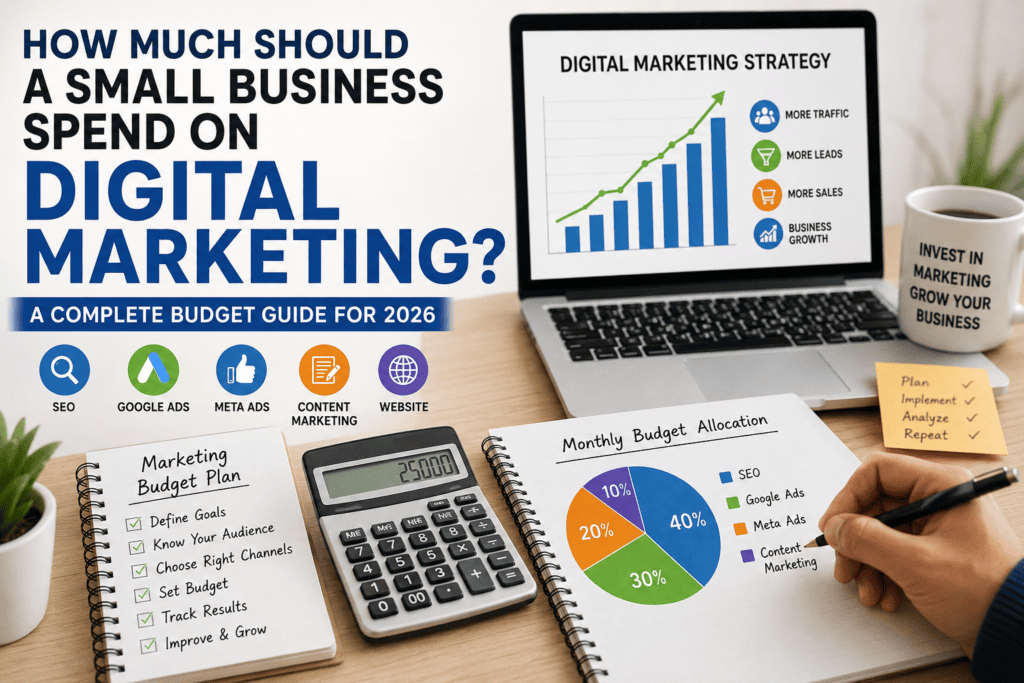
Digital marketing is one of the smartest investments a small business can make. It helps you reach more customers, generate quality leads, and grow your sales without spending money on traditional advertising. However, many business owners have one common question: How Much Should a Small Business Spend on Digital Marketing?
At DigitalOrbitz, we help small and medium-sized businesses build a strong online presence through SEO, Google Ads, Meta Ads, website development, and social media marketing. Our goal is to create marketing strategies that fit your budget and deliver measurable business growth. This guide explains how to decide the right digital marketing budget for your business and where to invest it for the best results.
How Much Should a Small Business Spend on Digital Marketing?
There is no single answer that fits every business. Your ideal budget depends on your business size, industry, competition, goals, and revenue.
Most marketing experts recommend spending 7% to 12% of your annual revenue on marketing if your business is already established. If you have recently started your business or want faster growth, you may need to invest 10% to 20% of your annual revenue.
The important thing is not spending more money. The important thing is spending your budget wisely on the right digital marketing channels.
For example:
| Monthly Revenue | Recommended Digital Marketing Budget |
|---|---|
| ₹50,000 | ₹5,000–₹10,000 |
| ₹1,00,000 | ₹10,000–₹20,000 |
| ₹3,00,000 | ₹25,000–₹50,000 |
| ₹5,00,000 | ₹40,000–₹80,000 |
| ₹10,00,000+ | ₹75,000–₹2,00,000 |
These numbers are only guidelines. Some businesses can grow with a smaller budget, while highly competitive industries may need to invest more.
Why Digital Marketing Is an Investment, Not an Expense
Many business owners think marketing is an extra cost. In reality, digital marketing helps your business earn more revenue.
Imagine you spend ₹20,000 on Google Ads and generate sales worth ₹2,00,000. Your marketing has created much more value than it cost.
Good digital marketing helps you:
- Increase website traffic
- Generate quality leads
- Build brand awareness
- Improve customer trust
- Increase online sales
- Grow your business faster
- Stay ahead of competitors
Instead of asking, “How much should I spend?” ask, “How much return can I earn from my marketing investment?”
Factors That Decide Your Digital Marketing Budget
Every business has different goals. Before deciding your budget, consider these important factors.
1. Your Business Goals
Start by asking yourself what you want to achieve.
Your goal may be:
- Generate more leads
- Increase online sales
- Build brand awareness
- Grow website traffic
- Get more phone calls
- Increase walk-in customers
- Improve local visibility
Different goals require different marketing strategies.
For example, if you want quick leads, Google Ads may work better than SEO. If you want long-term traffic, SEO is usually the better choice.
2. Your Industry
Some industries have higher competition than others.
For example:
- Real Estate
- Legal Services
- Healthcare
- Finance
- Education
These industries usually have higher advertising costs.
On the other hand, local shops, restaurants, gyms, and service businesses often need a smaller marketing budget to reach nearby customers.
Understanding your industry helps you set realistic expectations.
3. Your Business Stage
A new business and an established business have different marketing needs.
New Business
A new business needs to:
- Build brand awareness
- Create a website
- Set up Google Business Profile
- Build social media pages
- Start SEO
- Run advertising campaigns
Because everything starts from zero, the initial investment is usually higher.
Established Business
An existing business already has customers and online visibility.
It can focus on:
- Improving SEO
- Scaling Google Ads
- Increasing conversions
- Retargeting previous visitors
- Building customer loyalty
The marketing budget often becomes more efficient over time.
4. Your Competition
Search for your main services on Google.
Ask yourself:
- Are competitors running Google Ads?
- Do they rank on the first page?
- Are they active on Instagram and Facebook?
- Do they have hundreds of Google reviews?
If your competitors invest heavily in digital marketing, you need a competitive strategy to stand out.
That does not always mean spending more money. It means spending smarter.
5. Your Service Area
A local business usually needs a smaller budget than a business serving the entire country.
For example:
A plumber serving only one city can target a smaller audience.
An e-commerce business selling across India competes with thousands of businesses. It usually needs a larger marketing budget.
Local businesses can reduce costs by focusing on:
- Local SEO
- Google Business Profile optimization
- Location-based Google Ads
- Facebook Ads targeting nearby customers
Where Should Small Businesses Spend Their Digital Marketing Budget?
One of the biggest mistakes business owners make is putting all their money into one platform.
A balanced strategy usually produces better results.
Here are the main digital marketing channels.
Search Engine Optimization (SEO)
SEO helps your website appear in Google’s organic search results.
Benefits include:
- Long-term traffic
- Higher trust
- Better brand authority
- Lower cost over time
- Consistent lead generation
SEO takes time, but the results can last for years.
Typical monthly investment:
₹10,000–₹50,000+
depending on competition and business size.
Google Ads
Google Ads gives you immediate visibility.
Your website can appear at the top of search results within hours.
Google Ads works well for:
- Emergency services
- Local businesses
- High-intent buyers
- Lead generation
- E-commerce stores
Since users are already searching for your services, Google Ads often produces high-quality leads.
Typical monthly budget:
₹10,000–₹1,00,000+
depending on your industry and location.
Meta Ads (Facebook & Instagram)
Meta Ads help businesses reach people based on their interests, age, location, and behavior.
These ads work well for:
- Brand awareness
- Product promotions
- Local businesses
- Events
- E-commerce
- Remarketing campaigns
Meta Ads are especially useful when you want to introduce your business to new customers before they actively search for your services.
Content Marketing
Content marketing helps you attract customers by providing useful information instead of directly selling your services.
Good content includes:
- Blog articles
- Case studies
- Videos
- Infographics
- Guides
- FAQs
- Email newsletters
When you publish helpful content regularly, Google starts seeing your website as a trusted source. This improves your SEO and brings more organic visitors over time.
Benefits of Content Marketing
- Improves search engine rankings
- Builds customer trust
- Generates long-term website traffic
- Supports social media marketing
- Helps convert visitors into customers
For most small businesses, publishing 2–4 high-quality blog posts each month is a good starting point.
Social Media Marketing
Many business owners think posting random photos on Instagram is enough. It is not.
A good social media strategy focuses on educating, engaging, and building trust.
Your content can include:
- Customer success stories
- Tips and guides
- Behind-the-scenes videos
- Before-and-after results
- Business updates
- Industry news
- Frequently asked questions
When people trust your brand, they are more likely to contact you when they need your service.
Website Development and Maintenance
Your website is your digital storefront.
Even the best marketing campaign will fail if your website is slow, confusing, or difficult to use.
A professional website should have:
- Fast loading speed
- Mobile-friendly design
- Clear call-to-action buttons
- Easy navigation
- Secure HTTPS connection
- Contact form
- WhatsApp button
- Service pages
- Customer testimonials
A well-designed website increases conversions without increasing your advertising budget.
Email Marketing
Email marketing remains one of the highest ROI marketing channels.
You already paid to acquire your customers. Email helps you stay connected with them.
You can send:
- Offers
- Product updates
- Seasonal promotions
- Helpful tips
- Business news
- New blog posts
Email marketing encourages repeat business and builds long-term relationships.
Sample Monthly Digital Marketing Budgets
Here are some example budgets for different business sizes.
Budget Plan 1: ₹15,000 per Month
Best for:
- Local shops
- Startups
- Small service businesses
Suggested allocation:
| Marketing Activity | Budget |
|---|---|
| SEO | ₹5,000 |
| Google Ads | ₹5,000 |
| Meta Ads | ₹3,000 |
| Content Marketing | ₹2,000 |
This plan focuses on building visibility while generating a steady flow of leads.
Budget Plan 2: ₹30,000 per Month
Best for:
- Growing businesses
- Local brands
- Clinics
- Educational institutes
Suggested allocation:
| Marketing Activity | Budget |
|---|---|
| SEO | ₹10,000 |
| Google Ads | ₹10,000 |
| Meta Ads | ₹5,000 |
| Content Marketing | ₹5,000 |
This combination creates both short-term and long-term growth.
Budget Plan 3: ₹50,000 per Month
Suitable for businesses that want faster growth.
Suggested allocation:
| Marketing Activity | Budget |
|---|---|
| SEO | ₹15,000 |
| Google Ads | ₹20,000 |
| Meta Ads | ₹10,000 |
| Content Marketing | ₹5,000 |
This plan allows you to build organic rankings while generating leads through paid advertising.
Budget Plan 4: ₹1,00,000+ per Month
Suitable for:
- Established businesses
- E-commerce brands
- Businesses expanding into new cities
Suggested allocation:
| Marketing Activity | Budget |
|---|---|
| SEO | ₹30,000 |
| Google Ads | ₹40,000 |
| Meta Ads | ₹20,000 |
| Content Marketing | ₹10,000 |
This budget supports aggressive growth and brand expansion.
Should You Spend More on SEO or Paid Ads?
This is one of the most common questions.
The answer depends on your goals.
Choose SEO If You Want
- Long-term traffic
- Lower cost over time
- Better Google rankings
- Brand authority
- Consistent leads
SEO takes time, but it keeps delivering results even after months.
Choose Google Ads If You Want
- Immediate traffic
- Quick leads
- Fast sales
- Seasonal promotions
- Product launches
Google Ads produce faster results but require continuous spending.
The Best Strategy
Most successful businesses use both.
For example:
- Google Ads generate leads today.
- SEO builds free traffic for tomorrow.
This combination creates sustainable business growth.
Common Mistakes Small Businesses Make
Many businesses waste their marketing budget because they make avoidable mistakes.
Here are some of the most common ones.
1. Spending Without a Plan
Running ads without clear goals often leads to poor results.
Always define your objective before spending money.
For example:
- Increase phone calls
- Generate leads
- Get website enquiries
- Increase online sales
Clear goals make it easier to measure success.
2. Ignoring SEO
Some businesses only invest in paid advertising.
When they stop running ads, their leads disappear.
SEO continues bringing visitors even when you reduce your advertising spend.
3. Expecting Instant Results
Digital marketing needs patience.
SEO usually takes several months to show strong results.
Social media also takes time to build trust.
Businesses that stay consistent usually achieve better long-term growth.
4. Not Tracking Results
If you do not measure your campaigns, you cannot improve them.
Track important metrics like:
- Website visitors
- Leads
- Phone calls
- Cost per lead
- Conversion rate
- Return on investment (ROI)
Good decisions come from good data.
5. Having a Poor Website
Many businesses spend thousands on ads but send visitors to a slow or outdated website.
A poor website can reduce conversions, even if your advertising is excellent.
Regularly update your website to improve user experience.
6. Targeting Everyone
Trying to reach everyone usually means reaching no one.
Instead, define your ideal customer.
For example:
- Business owners
- Local customers
- Students
- Parents
- Healthcare professionals
A focused audience produces better marketing results.
7. Posting Without a Strategy
Random social media posts rarely generate business.
Create a content calendar that includes:
- Educational posts
- Customer reviews
- Industry tips
- Short videos
- Success stories
- Frequently asked questions
Consistency helps build trust and keeps your audience engaged.
How to Measure the Return on Your Digital Marketing Budget
Spending money on digital marketing is only one part of the process. You also need to know if your investment is bringing results.
Many small business owners focus only on how much they spend. Successful businesses focus on what they earn from that spending.
This is called Return on Investment (ROI).
Simple ROI Formula
You can calculate ROI using this formula:
ROI = (Revenue Generated – Marketing Cost) ÷ Marketing Cost × 100
Example
Let’s say:
- Monthly marketing budget: ₹30,000
- Revenue generated from marketing: ₹1,80,000
ROI = (₹1,80,000 – ₹30,000) ÷ ₹30,000 × 100
ROI = 500%
This means every ₹1 spent on marketing returned ₹6 in revenue.
Key Metrics Every Small Business Should Track
Do not judge your marketing only by likes or followers. Focus on numbers that directly impact your business.
Website Traffic
Check:
- How many people visit your website
- Which pages they visit
- How long they stay
- Which source brings the most visitors
If traffic keeps growing, your SEO and content strategy are working.
Leads Generated
Track how many people:
- Fill out your contact form
- Call your business
- Send a WhatsApp message
- Request a quote
- Book an appointment
More qualified leads usually mean better marketing performance.
Cost Per Lead (CPL)
Cost Per Lead tells you how much you spend to acquire one potential customer.
Example:
- Marketing spend: ₹20,000
- Leads generated: 100
Cost Per Lead = ₹200
Lower CPL often means your campaigns are becoming more efficient.
Conversion Rate
Not every lead becomes a customer.
Your conversion rate shows how many leads actually buy from you.
Example:
- 100 leads
- 20 customers
Conversion Rate = 20%
Improving your sales process can increase conversions without increasing your marketing budget.
Customer Acquisition Cost (CAC)
CAC tells you how much it costs to gain one paying customer.
Example:
Marketing Cost = ₹50,000
New Customers = 25
Customer Acquisition Cost = ₹2,000
If each customer earns you ₹20,000, your marketing is performing well.
Digital Marketing Budget by Business Type
Different businesses need different strategies. Here are some general recommendations.
Local Service Businesses
Examples:
- Plumbers
- Electricians
- Interior Designers
- Digital Marketing Agencies
- Pest Control Services
- Repair Services
Recommended monthly budget:
₹15,000–₹50,000
Focus on:
- Local SEO
- Google Business Profile
- Google Ads
- Customer Reviews
- WhatsApp Lead Generation
Restaurants and Cafés
Recommended monthly budget:
₹10,000–₹40,000
Priority channels:
- Google Maps
- Google Ads
- Food photography
- Local SEO
Medical Clinics
Recommended monthly budget:
₹25,000–₹75,000
Focus on:
- Local SEO
- Google Ads
- Patient reviews
- Educational blogs
- Appointment booking system
Educational Institutes
Recommended monthly budget:
₹30,000–₹1,00,000
Marketing channels:
- Google Search Ads
- YouTube Ads
- Meta Ads
- SEO
- Landing pages
- Email marketing
E-commerce Stores
Recommended monthly budget:
₹40,000–₹2,00,000+
Focus on:
- Google Shopping Ads
- Meta Ads
- SEO
- Email marketing
- Remarketing
- Conversion optimization
When Should You Increase Your Marketing Budget?
Many businesses continue spending the same amount for years.
Instead, increase your budget when you see positive results.
Good signs include:
- Your leads are increasing every month.
- Your cost per lead is decreasing.
- Your website traffic keeps growing.
- Your sales team can handle more enquiries.
- Your ROI remains strong.
- Your business is entering a new market.
Scaling successful campaigns usually brings better returns than constantly testing new ones.
Signs You May Be Spending Too Little
Sometimes the biggest problem is not overspending. It is underinvesting.
You may need to increase your budget if:
- Your competitors dominate Google search results.
- You receive very few enquiries.
- Your website gets little traffic.
- Your business depends only on referrals.
- Your social media pages are inactive.
- Your sales have stopped growing.
A small increase in your marketing budget can often create a much bigger increase in revenue.
Signs You May Be Spending Too Much
More spending does not always mean better results.
Review your campaigns if:
- Leads are not increasing.
- Cost per lead keeps rising.
- Website visitors leave quickly.
- Your conversion rate is falling.
- Sales remain flat despite higher spending.
In these situations, optimize your strategy before increasing your budget.
A Simple 12-Month Digital Marketing Plan
A long-term plan helps you grow steadily instead of making random marketing decisions.
Months 1–3: Build a Strong Foundation
Focus on:
- Professional website
- Google Business Profile optimization
- Keyword research
- Basic SEO
- Google Analytics setup
- Google Search Console setup
- Social media profile optimization
The goal is to create a strong online presence.
Months 4–6: Start Lead Generation
Begin investing in:
- Google Ads
- Meta Ads
- Local SEO
- Blog publishing
- Customer reviews
- Landing pages
Track every lead and identify your best-performing channels.
Months 7–9: Optimize Performance
Analyze your data.
Improve:
- Ad copy
- Keywords
- Website speed
- Landing pages
- Call-to-action buttons
- Content quality
Small improvements can significantly increase conversions.
Months 10–12: Scale What Works
Increase investment in the channels that deliver the highest ROI.
For example:
- Expand successful Google Ads campaigns.
- Publish more SEO content.
- Launch remarketing campaigns.
- Create video content.
- Build email automation.
Avoid spreading your budget across too many platforms. Focus on the channels that consistently generate results.
Expert Tips from DigitalOrbitz
At DigitalOrbitz, we have seen that small businesses achieve better results when they focus on strategy rather than simply increasing their budget.
Here are some practical tips:
- Set clear business goals before launching any campaign.
- Invest in both SEO and paid advertising for balanced growth.
- Keep your website updated and mobile-friendly.
- Publish valuable blog content regularly.
- Encourage satisfied customers to leave Google reviews.
- Monitor campaign performance every month.
- Use data to make decisions instead of guessing.
- Be patient and stay consistent. Sustainable growth takes time.
Businesses that follow these practices often build stronger online visibility and generate more qualified leads over the long term.
How to Get the Most Value from Your Digital Marketing Budget
A good budget alone will not guarantee success. You also need a smart strategy. Many small businesses spend money on marketing without a clear plan. As a result, they do not get the returns they expect.
To maximize every rupee you invest, follow these best practices:
1. Set Clear Goals
Before starting any campaign, decide what you want to achieve.
Your goals may include:
- Generate more leads
- Increase website traffic
- Get more phone calls
- Improve online sales
- Build brand awareness
- Increase repeat customers
When you have clear goals, it becomes easier to measure success.
2. Understand Your Target Audience
You should know:
- Who your ideal customers are
- What problems they face
- What services they need
- Which platforms they use
- What motivates them to buy
The better you understand your audience, the better your marketing results will be.
3. Invest in High-Quality Content
Helpful content builds trust.
Create content such as:
- Blog articles
- Videos
- FAQs
- Case studies
- Customer success stories
- How-to guides
Google rewards websites that consistently publish useful and original content.
4. Improve Your Website Regularly
Your website should make it easy for visitors to contact you.
Review your website every few months and improve:
- Loading speed
- Mobile responsiveness
- Navigation
- Contact forms
- Service pages
- Call-to-action buttons
A better website often leads to more enquiries without increasing your advertising budget.
5. Track and Improve
Digital marketing is not a one-time activity.
Review your campaigns every month.
Ask questions like:
- Which campaigns generated the most leads?
- Which keywords performed best?
- Which ads had the highest click-through rate?
- Which landing page converted the most visitors?
Continuous improvement leads to better long-term results.
Digital Marketing Budget Checklist for Small Businesses
Use this simple checklist before deciding your monthly budget.
✅ Define your business goals.
✅ Identify your target audience.
✅ Build a professional website.
✅ Optimize your Google Business Profile.
✅ Start basic SEO.
✅ Publish useful blog content regularly.
✅ Run Google Ads for immediate leads.
✅ Use Meta Ads to increase brand awareness.
✅ Collect Google reviews from satisfied customers.
✅ Track leads and conversions every month.
✅ Review campaign performance regularly.
✅ Increase your budget only when campaigns deliver a positive ROI.
Final Thoughts
So, how much should a small business spend on digital marketing?
The answer depends on your business goals, industry, competition, and growth plans. There is no fixed amount that works for every business. However, most small businesses should consider investing 7% to 12% of their annual revenue in marketing. Businesses looking for faster growth may choose to invest even more.
Instead of trying to spend the least amount possible, focus on getting the highest return from every rupee you invest.
A balanced strategy that combines SEO, Google Ads, Meta Ads, content marketing, website optimization, and local SEO often delivers the best long-term results. Remember that digital marketing is an ongoing process. Consistency, regular optimization, and tracking your performance are the keys to sustainable growth.
If your business is not getting enough enquiries today, now is the right time to create a marketing strategy that helps you attract more customers, build trust, and grow your revenue.
Why Choose DigitalOrbitz?
At DigitalOrbitz, we help small and medium-sized businesses grow through result-driven digital marketing solutions. Whether you need Search Engine Optimization (SEO), Google Ads, Meta Ads, Website Development, Local SEO, Social Media Marketing, or Content Marketing, our team creates customized strategies based on your business goals and budget.
We believe in transparency, measurable results, and long-term growth. Instead of using a one-size-fits-all approach, we study your business, understand your audience, and build campaigns that generate quality leads and improve your online presence.
If you’re ready to invest in digital marketing the right way, DigitalOrbitz is here to help you grow with confidence.
Frequently Asked Questions (FAQs)
1. How much should a small business spend on digital marketing each month?
Most small businesses spend between ₹10,000 and ₹50,000 per month, depending on their revenue, industry, competition, and business goals. Businesses aiming for rapid growth may invest more.
2. Is SEO better than Google Ads?
Both have different purposes. SEO builds long-term organic traffic and trust, while Google Ads delivers immediate visibility and leads. A combination of both usually provides the best results.
3. How long does digital marketing take to show results?
Paid advertising, such as Google Ads and Meta Ads, can generate leads within days. SEO and content marketing typically take 3 to 6 months to produce noticeable improvements, depending on your competition and website.
4. What is the minimum budget for digital marketing?
A small local business can start with a budget of ₹10,000 to ₹15,000 per month. As results improve, the budget can be increased gradually to scale growth.
5. Which digital marketing channel gives the highest ROI?
The answer depends on your business type. For many service-based businesses, SEO and Google Ads often provide excellent returns. For e-commerce businesses, a combination of Google Shopping Ads, Meta Ads, and email marketing can be highly effective.
6. Should I hire a digital marketing agency or do it myself?
If you have the time and expertise, you can manage some marketing tasks yourself. However, partnering with an experienced agency can save time, reduce costly mistakes, and help you achieve faster, more consistent results.
7. How do I know if my marketing budget is working?
Track key performance indicators such as:
- Website traffic
- Leads generated
- Cost per lead
- Conversion rate
- Customer acquisition cost
- Return on investment (ROI)
Review these metrics every month and adjust your strategy based on the data.
8. Can a small business compete with larger companies online?
Yes. With a well-planned digital marketing strategy, high-quality content, strong local SEO, and targeted advertising, small businesses can compete effectively and attract qualified customers without matching the budgets of larger brands.
)